Pages

Showing posts with label issues. Show all posts

Saturday, March 9, 2013

Negative Reviews: Why I Write Them and Why I Read Them


The other day, I wrote an admittedly biting review of The Prince by Kiera Cass. I went into it knowing I would probably not enjoy it, and I didn't. You could argue this isn't fair of me, and in some ways you could be right. I was pretty clear in the review that there is something about the series that keeps me reading, to their credit, which is why I read The Prince. I was hoping to like it. But I've also been pretty clear about the fact that I review every book I read except for the ones I don't finish. And that means I'm going to post critical reviews, because I will always express the way I feel. I'm not going to lie about my feelings for a book. And it just so happens I naturally express myself in jokes.

How some people see me
This is also not me (okay maybe it's me a little bit)

A book review blog is meant to review books. I'm more critical than the average person, and my job here as a reviewer is to point out to people what I felt worked about a book and what I felt didn't. I'm here to help other readers make informed decisions, even when I know a lot of people aren't going to agree with me. This is why it's great that there's such a variety of bloggers. You get as many varying opinions as you need to help guide you in the direction of books that will work for you. Before picking up a book, I always make sure to read negative AND positive AND in-between reviews. Because all of those opinions are valid. All of those opinions are correct.

The problem with this, though, is that I can get pretty mean. I'm aware of that. I've always thought published material, sent out into the world to be judged on its own merits, is eligible for whatever snarkery it incurs, but not all people agree. I get that. We're all human beings, and all creativity should be rewarded, not discouraged, right?


As an aspiring author, I should agree with this. I know it would probably break my heart to learn someone hated my work to such a degree that they felt the need to rip it to shreds. But let’s face it: that’s the deal. If you’re lucky enough to get your novel into the sphere of public consumption, some people aren’t going to like it. It’s a fact. Your book is not a hundred dollar bill or a really big cookie, which means it will not be popular with everyone. Case in point: some people hate chocolate. If chocolate isn't universally beloved, then your book doesn't stand a chance.


How much hate is too much hate? That's a personal question, of course, and everybody will have a different answer. I'm in the camp of people who don't believe in critical kid gloves. I believe that humor at the expense of a book is fair game (humor at the expense of the AUTHOR is a different story). I am also in the camp of people who think it is significantly MORE hateful to go on somebody else's blog and tell that person that they suck, that they're a bitch, that they should leave poor Author X alone, and that the blogging world would be better off without them.

Getting mean emails gives me the sads.

That, my friends, is the kind of internet hate I don't like.

When I post my negative reviews on Twitter, I never @reply the author with a link to my review. I do not go on the author's website and tell them how much I hated their book. I do not go to fan-sites or forums or tumblrs and tell the people there that I think their bookish opinions are stupid. Because they AREN'T. They just happen to deviate from mine, and that's okay.

I'll admit: I've got a snarky streak a mile wide. I LOVE ripping on books, movies, TV shows, and acquaintances who tick me off. I know that's probably not a serious virtue in my character, but it is what it is. I don't purposefully review books in the hopes that they are terrible and I get to savage them on the internet (except for Modelland, but that is barely even a real book). If I read a book I hate, you can bet your bottom dollar I'm going to make fun of it in my review. I like humor. I'm going to make jokes. You can like it or lump it.

What you can't do is send me anonymous vitriol in email form. This is cyber-bullying. It doesn't matter how justified you feel, or how much you love the book I hate. Please, please, PLEASE DO NOT DO THIS.

Anderson does not approve.

A sampling of the super fun, super real comments I've received as of late:

i dont find sense in the things you say here. sorry, but your being a mean bitch here. please think about the authors you are hurting with your mean words. as if you could write any better than that

I think my favorite parts of that email were the sorry and the please. Your rudeness is so polite.

WHY did you feel the need to post such a vicious review on the internet? Don't you think there is enough hate floating out there? WHY do you feel the need to contribute more hate? I am sorry, but I will no longer be following your reviews. I am disgusted by this. As a lover of [book title redacted], I am deeply offended on behalf of the author.

This particular email has some sense in it (and also a basic command of grammar), even if those words did hurt. Yes, there is a lot of hate floating out there, and it's not my intention to contribute more of it. But I think going out of your way to send a message like this to a perfect stranger is a much more personal form of hate.


YOU ARE STUPID FOR THINKING THIS BOOK IS BAD. IT IS A BRILLIANT BOOK AND YOU OBVIOUSLY DO NOT UNDERSTAND WHAT A GOOD BOOK IS. I BET YOUR BOOKS WILL BE CRAP I HOPE YOU ARE PUBLISHED AND SOMEDAY SOMEONE WRITES A NASTY REVIEW OF YOUR BOOK AND I WILL LAUGH


The hypocrisy in this one is astounding. Not only is it ridiculous (I obviously don't understand what a good book is?!?!?!), but do you really not see that you are bashing someone for writing a negative review by advocating for someone to write another negative review? And also, I agree with you. I also hope I am published! I hope my future book is well-read enough that someone out there will write something horrible about it. Because, as said, books are not hundred dollar bills. No book is universally beloved. There will always be haters. Will bad reviews hurt? Undoubtedly. I'm a sensitive flower. I want people to like me and the words I write. But all a bad review means is I did something wrong in my writing.

"The novel is a prose narrative of some length that has something wrong with it." --Samuel Johnson

Also, notice a trend here? I am not getting angry emails from authors, or publishers, or agents, not even for the books I have received for review from said publishers. My review for Confessions of an Angry Girl, written after I received an ARC from Harlequin Teen, had a healthy dose of criticism. Harlequin Teen read the review and then retweeted it, saying they enjoyed reading it. Because, by weighting out the good AND the bad, I helped a lot of people decide whether that book was the book for them.

I want books to be good. I looooove books. Books are the be-all and end-all of my life. The vast majority of my reviews are positive because I'm pretty good at picking out books that I'm going to like. Sometimes, I get it wrong, of course, and sometimes I may go too far in critiquing a book I don't like. And I am sorry if I offend any of my readers, I truly am. That is not my intention. I want to make perfectly clear that I respect different bookish opinions. Everybody brings a lifetime's worth of thoughts, memories, and feelings to every book they read. Because of that, no two people will feel exactly the same way about a book. It's just impossible. A romance that may make Reader A swoon might make Reader B roll her eyes. Books are just plain subjective. Neither reader is right or wrong. Neither is stupid or smart. They just are.


Up until this point, the book blogging community has been nothing but an ultra loving place, full of collective bibliophilia and unending support. I know this experience is nothing but a fluke. The stream of hate mail I've gotten has prompted me to change my email, but it's certainly not going to make me change my reviewing style or leave the blogosphere entirely. So let's all have a BIG DRINK, plow forward, and leave this messiness behind, okay? I know of several good books we could read to make ourselves feel better.


Monday, February 18, 2013

How to Get Out of a Reading Rut


My brain in a reading rut

I feel like there are two definitions of a reading rut: either you're stuck in one genre (help! I'm stuck in a genre and I can't get out!), or you're just stuck in general. You've tried a million different books, but they're just not clicking for you. You've stopped and started a million times, and while usually you're gobbling down books like they're potatoes chips, for some reason things have slooooowed dowwwwwn.

This post is about the second type: the reading brain block. Otherwise known as the book blogger's most deadly affliction.

Some of you are probably looking at me your computer screen like I'm crazy (stop doing that, you look stupid making faces at an inanimate object). "Um. That never happens to me. I have no idea what you're describing." Those people are lucky. But the rest of us, and even the most voracious of readers, sometimes just get stuck.

Picture the scene: the humble book blogger sits in her room, gazing sadly at the ceiling. Books overflow from her shelves, piled into stacks three feet high, spilling over the floor. She thumbs through her e-reader and sees over a hundred unread books. Heaps of reviews are due. The people expect them, and the publishers expect them, but there's just one problem. SHE'S GOT NOTHING TO READ! Every book she picks up might as well be written in a foreign language, because something just isn't working.

Gillian will stop talking about herself in the third person now.

This is how I was two weeks ago. Things just weren't grabbing me. I wasn't in the right headspace or something, and it was devastating. My favorite feeling in the world is falling so deeply into a book that it just swallows me whole, and I forget I'm even on planet earth and that I'm more than just a pair of eyeballs blazing across pages. But you can't force that to happen, sadly.

But in the end, I managed to break out of my reading rut (huzzah!), and it ended up being very educational. Now I shall share with you a few of the tips I picked up for busting free.

Get thee to a library! When I buy books from bookstores or online, I always feel enormous pressure to read it, even if it's not grabbing me, because I paid good money. I owe it to my wallet and the good meal I gave up in exchange for purchasing the book to read the darn thing and read it now. But often when you feel pressured to read a certain book, those are the times where it just ain't happenin'. So the library is a perfect place to grab something for free. If you don't find the time or impetus to get into the borrowed book, then no worries! It either goes back to the library and you get something new, or you try taking it out another week. No consequences.

Read a sequel you are positively salivating for. You're already eager for it. You already know and love the characters, so there won't be that awkward first-date period where you're wary and you're brow is furrowed and you're withholding judgment.

Harry is doubtful.

My rut basically ended the day I got Unravel Me, and it sparked the magic. I got it at about three in the afternoon and finished it around eleven. AND I went out to dinner that night like an actual socializing person (which I am not. I mean, I'm still a PERSON, but I tend to not be the best with situations that are social. I didn't even want to GO to dinner, but I was forced by people who have no patience for bookish shut-ins).


Choose a genre you really, unapologetically love. One you're predisposed to enjoy, and hits you where you're hittable. Love books with ghosts? Try horror. Love magic? Pick up a fantasy.

I recommend, though, that you try contemporary. Unless you're one of those people who just can't STAND it, of course, but I think it's the best way to ease yourself back into the rhythm of reading. And while I run into a lot of contemporaries that just don't work for me, a really fun and funny contemp read is the perfect thing to pull me out of a reading brain block. For one, there's no tricky worldbuilding. It requires much less tax on your brain, because it's about the world you live in, and you already understand all the rules. You don't have to concentrate the first fifty pages or so. If I'm in a rut, my brain is overtaxed and unable to focus, which means I'm less likely to absorb crucial information.

Try setting aside a specific time for reading. Before bed, during lunch, whenever. When that time comes around, your brain will know it's time for booking (yes it's a verb), and you'll be more likely to get into your book.

Read a book that's getting a LOT of great buzz... or don't. Yeah, that one's contradictory, because it can go both ways. Either you're guaranteed a fab read, or you'll be disappointed and feel like the one dense person on the planet who just doesn't get it. Tread with caution here.

Read something that's unapologetically trashy/fluffy/funny. These are NOT BAD THINGS. They are awesome things. Find your personal guilty pleasure kryptonite, like a romance so cheesy you just know you'll roll your eyes but inside you just might be squealing. Something that won't challenge your brain cells but will engage your heart.

My brain FINALLY GETTING BACK INTO THE SWING OF THINGS

Read with a friend! You'll feel more motivated, plus you'll have someone to share the experience with. You can fangirl or complain together.

REREAD. Reread reread reread. Go back and revisit a book you know you love, one that is guaranteed to suck you in. It's like visiting an old friend when you need a pick me up. Preferably choose a book that you adore but perhaps haven't read in a little while. This always does the trick for me. It's like warming up before starting the big race of reading something new.

So! How do you haul yourself out of the dreaded reading rut? Are you one of those lucky people who is NEVER burnt out reading-wise? Tell us where you live, so we can throw things at you in a jealous rage (don't actually tell us where you live). Which of my tips do you think could or couldn't work for you?


Wednesday, January 2, 2013

Rant and Review: Undeadly by Michele Vail


Review: Undeadly by Michele Vail
Rating: A rant is forthcoming.

 
"The day I turned 16, my boyfriend-to-be died. I brought him back to life. Then things got a little weird..."

Molly Bartolucci wants to blend in, date hottie Rick and keep her zombie-raising abilities on the down-low. Then the god Anubis chooses her to become a reaper—and she accidentally undoes the work of another reaper, Rath. Within days, she's shipped off to the Nekyia Academy, an elite boarding school that trains the best necromancers in the world. And her personal reaping tutor? Rath.

Life at Nekyia has its plusses. Molly has her own personal ghoul, for one. Rick follows her there out of the blue, for another...except, there's something a little off about him. When students at the academy start to die and Rath disappears, Molly starts to wonder if anything is as it seems. Only one thing is certain—-Molly's got an undeadly knack for finding trouble...

 
WARNING: I am mean. I am so mean. I am unfairly, ridiculously, crazily mean. There be snarkiness ahead, sailors. If you loved this book, or if you are opposed to negativity in the blogosphere (which is a valid opposition to have), you may want to step away. You have been warned.

Oh, Undeadly. You are a book with so much promise. I love that synopsis. I loved the mythology. I loved so many aspects of the plot. I’ve never read a YA book that focused on the Egyptian gods and their underworld. Unfortunately, Undeadly is not the book it appears to be.

There's a lot to like here, and a lot that bugged me. Truthfully, not a lot happens. Most of the plot is Molly drooling over her almost-boyfriend, reacting to mean girls, and inexplicably getting hit on by a hot, mysterious dude named Rath, about whom we receive nearly no information. None of the secondary characters are developed at all. In the world Vail has created, necromancers are common. It’s an alternate contemporary where zombies and those that raise the dead are a part of our history and our present. I straight up loved some of the aspects of Molly's everyday necromancer life while working at Al’s Zomporium and attending the Nekyia Academy. I found the idea of a necromancer boarding school completely fascinating. I adored every aspect of the mythology. And every now and then, Molly is legitimately funny.

“Not feeding a zombie is not like not feeding your cat. He. Will. Eat. You. And your cat.”

This indicated to me that Vail can seriously write. I think she's probably super talented. The world she’s invented is both hilarious and creative. There is so much potential in the reaper mythology, and sometimes her descriptions are perfect. But the narrator’s voice, to quote Molly herself, “made me want to yark.”

It is teen speak at its very worst: “kinda” “sorta” “um” “gotta” “It was a mondo ick mess”. All on the first page. I’m not saying teenagers don’t use those words. They do. I do (except for “mondo ick mess”, because this is not the twentieth century and my name is not Spicoli). Dropping them in your writing every now and then is realistic. A well-placed “um” is a thing of beauty. But these were all on one page, and not even in dialogue, but in Molly’s diary. She writes this way, like a twelve-year-old trying to sound cool. And even though her diary pages are very short and only show up every now and then, her first person narration is no better.

More examples:
“It ka-illlled me, but I smiled.”
"They were engrossed in a conversation that had something to do with Taylor Lautner."
“Gah! Who thought of that ridiculousness? Soooo unbelievable.”
"Booooooring."
"This was a whole 'nother level of WTH."
"Because hel-freaking-lo, I was going to boarding school."
“He imprisoned the gods in the bowels (Seriously? Ew!) of the Underworld.”

YOU IDIOT GIRL YOU ARE NOT LITERALLY DISCUSSING BOWELS THESE ONES ARE FIGURATIVE THERE IS NO PEE INVOLVED YOU KNOW HOW THIS WORKS. And stop saying BTW and TYVM in your own narration. You're not actually texting, so how hard is it to mentally say the words "by the way" and "thank you very much"? Especially since it took me a solid twenty seconds to figure out what TYVM even stood for because I am decrepit.

I’m sorry to turn this particular book into a scapegoat. I’ve run into a couple novels lately that have had this problem, but Undeadly, unfortunately, was the one that put me over the edge. It had its very real merits, but the irritating writing overshadowed them. I’m not trying to sound like a stuffy old fogey. I don’t require books to have impeccable grammar and advanced vocabulary. Those are not the only signs of intelligence. There are some amazing books written in colloquial form. If you follow my blog (or are reading this post), you know I don’t usually talk like a college professor.  I like slang, and funniness, and informality, but only when it’s natural. And my problem with Molly Bartolucci’s slangy teenage talk is not only that it sounds forced, but that it’s insulting. It’s insulting to the reader and it’s insulting to teenagers.

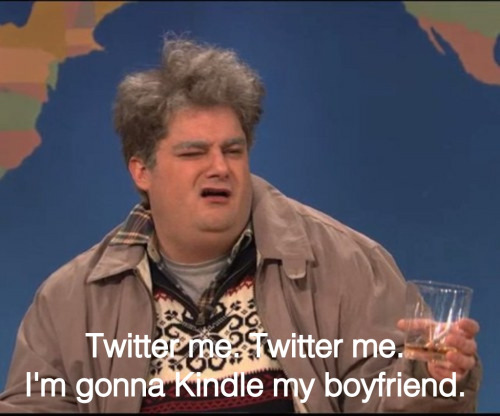
Molly sounds like an SNL parody of a teenager. She sounds like your Great Uncle Mort making fun of you after you accidentally say “totes” or something at the dinner table. Molly is Drunk Uncle.
 
 
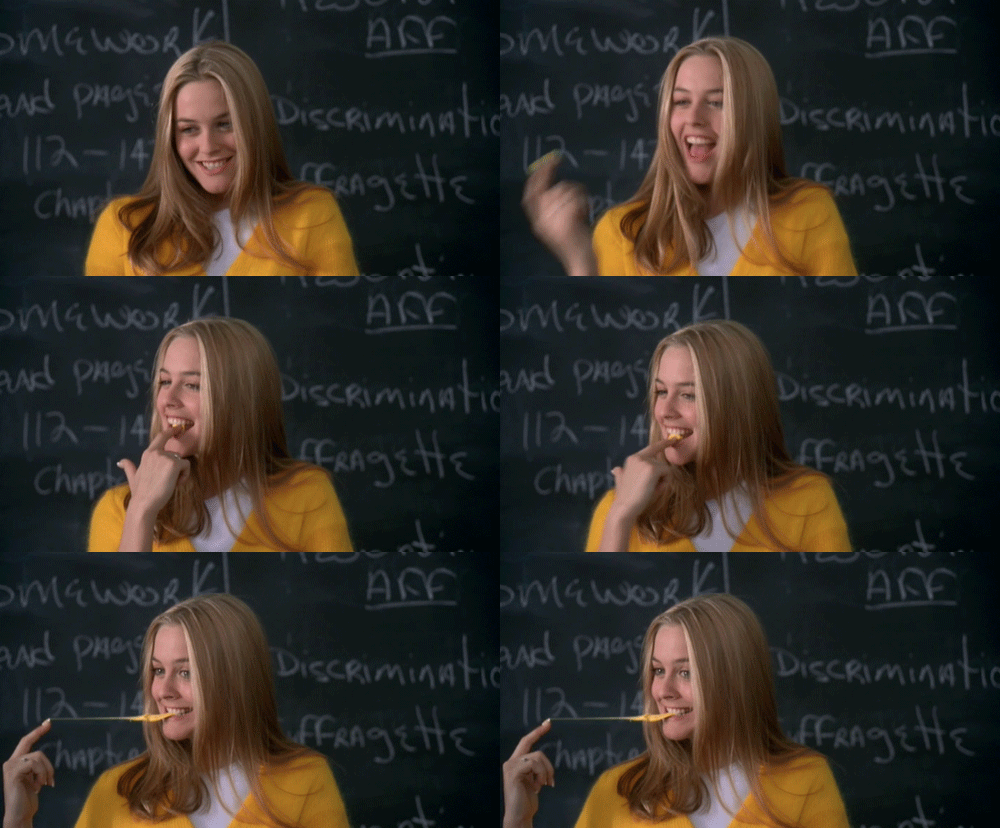
Sometimes, when writing YA novels, adult authors try so hard for their characters to sound young that they end up writing a parody of the teenage voice: dumb, shallow, and text speak-y.  And it's outdated text speak, too. They’re trying to make it sound like Clueless, even though Clueless came out eighteen years ago. One of the stereotypical mean girls in Undeadly literally says, "We're outtie" as she and her friends exit a party. And besides, Cher and her friends are not as dumb as people think they are.

Murray: Woman, lend me five dollars.
Dionne: Murray, I have asked you repeatedly not to call me "woman"!
Murray: Excuse me, Miss Dionne.
Dionne: Thank you.
Murray: OK, but street slang is an increasingly valid form of expression. Most of the feminine pronouns do have mocking, but not necessarily misogynistic, undertones.
Tai: Wow. You guys talk like grown-ups.
Cher: Oh, well, this is a really good school.

Clueless (1995)
 
Teenagers are smart. They are. They have worthy brains that are capable of doing this thing we call "thinking". When I was a teenager, four whole long years ago, nobody I knew talked like Molly. I know a lot of teenagers today, some of whom run very successful and intellectual book blogs, and they don't talk like that. Most of young adult literature is about teenagers thinking or learning to think about grownup issues of the world with their sometimes childlike brains. This doesn't mean they act like ten-year-olds all the time. When people assume teenagers are stupid-- despite the fact that most of the best writing out there is both written for and from the point of view of teenagers-- I get angry. Very, very angry.
 
 
Teenagers can see through condescension and insincerity in a second. They know what rings false. They know how to form complete sentences and complete words. Okay, perhaps not all of them. Spend enough time on Twitter and you’ll realize that there are a great many people whose syntax can make the English language cry. But these are not the kinds of people I generally want narrating my books, since books are literature and I expect some degree of coherency of thought. And yes, I know teenagers are not always very mature. I'm a twenty-one-year-old (with a brain that is permanently seventeen) and I make horrendous decisions. But I keep running into characters, like Molly, that are just stupid for stupid's sake. They act immaturely and shallowly and without logic because authors think that's a realistic way for teenagers to act. On the one hand, I love when characters make mistakes. All humans do that. All humans are dense or stupid or immature sometimes. But I just can't sympathize with a narrator who trusts absolutely everyone, even the obviously evil people, and who is Too Stupid To Live.
 
 
She thinks her English teacher would be proud of her using the word "fragrant", like she just casually dropped “antidisestablishmentarianism” or “houppelande”. She is disappointed when her boyfriend gives her a book without pictures or writing (otherwise known as a journal, Molly). Reading this kind of character makes me feel like the author thinks all teenage girls are too stupid to live. That they're spazzy, swoony ditzes who constantly roll their eyes at their "'rents" and whine "whatevs" and are incapable of realizing their own mistakes (not that there's anything wrong with saying "'rents" or "whatevs" or rolling your eyes. That doesn't make you automatically stupid). Molly refuses to even contemplate the very OBVIOUS way in which she's screwed up, nor does she ever think about the SERIOUS, FATAL, TRAGIC consequences she incurs. When the reader is light-years ahead of the narrator, intellect-wise, you wonder why you're even following along with her, or why you should care.

LIGHTYEAR GET IT SEE WHAT I DID THERE

Another book that I read recently that had this same problem was Radiate by Marley Gibson, a book about a teenage girl battling cancer. I loved that Hayley, the main character, was an upbeat cheerleader. It made a nice change from the average angsty and sarcastic narrator. But she and all her friends talked just like Molly, except maybe even worse. Every teen in the book texted in this kind of incomprehensible, all caps code that physically assaulted my eyes. It hurt to look at it.

GONNA B L8 2 PRACTICE CHECK UP AT DR 'RENTS SKEDULD
WISH I COULDA BRAWT MYSELF

This is not to say that adult authors can't write convincing teenage voices. Obviously they can, and do so every single day. But when it doesn't work, it really doesn't work. Radiate had some of the same problems that Undeadly had and some real strengths. But in both books, I couldn't get past the insincerity of the writing. It was more like how adults think teenagers talk than how they actually do.


The beginning of Undeadly is cluttered with clunky exposition, which, while interesting, is very inelegantly presented.  Basically Molly yatters for a while about all the mythology (“It was a mondo ick mess. Finally, Anubis went deep into the Underworld and got some badass magic. We’re talking magic so ancient and powerful, it wasn’t supposed to leave the world of the gods, like, ever.”), then goes “Aaaaanyway” and takes us back to the plot.

When Molly gives exposition to you, the reader, she sounds like a very lame high school teacher trying to be "hip with it". You know those teachers. They're the ones who make up raps and insultingly try to put things into simple terms they think you’ll understand. (“Let’s say Katie’s texting her friends at the mall, and she wants to buy four super cute pairs of shoes, but she only has, like, fifteen dollars, and her BFF is totally wiggin'…”) Like the teacher thinks you're too stupid to grasp the basic concept without them butchering a metaphor about some cliché aspect of teenage life.

And because Molly isn’t very intelligent, the book doesn’t feel intelligent. The reader isn't trusted to make any leaps of judgment, because Molly never does. It takes Molly one hundred and fifty pages to figure things out that the reader comprehended in seconds. Molly has small moments of true feeling and insight, moments where I let tiny little bubbles of hope swell in my chest that maybe Molly would finally grow. And then the very next sentence is literally "Whatevs", effectively popping my little hope bubble. This book seriously lacked depth.

I think the key to accurately writing a teenage voice is to not try to replicate a teenage voice. If the author lets their character be-- lets her suffer through those ordeals that are so unique to teenagedom-- then she'll sound authentic without you trying so hard. I sound horribly crotchety, I know. It's the New Year and vacation and I should be doing something relaxing like napping, not trashing books on the internet. And I honestly don't mean to trash anyone's work, or trash Vail as a writer, but when I read something that bothers me, I feel compelled to comment on it.

Generally, I like slang. But you need to know how to use it. You can't overdo it, you have to use it correctly, and you have to employ it in the right circumstances. If your main character is in a scary situation where someone is pointing a gun at her and all she says "Hoo-kay", then the reader really isn't going to feel much fear. There is SO MUCH POTENTIAL  in Undeadly that reading it kind of broke my heart. A boarding school for necromancers! Undead boyfriend! Hot, hot Rath! Destiny! Anubis! But the main character just killed every good thing in this book, and sadly, she was unable to resurrect it (everybody applaud my brilliant wordplay).


So there's my super long rant. Am I raving, as usual? Is my snark out of control? Is my soul blackened with hate and I need an exorcism to get all this negativity out of me? Or is this a pet peeve of yours too? If you did read Undeadly and thought Molly's voice was fine, I'd love to hear from you too. Did you have other problems with the book, or did you like it? Which books have you read that totally fail at capturing the teenage voice?

Friday, November 23, 2012

The Quandary of Boys in YA: A Rant


Not in the mood for my bilious stream of vitriol? Understandable. Go enter to win FREE BOOKS instead. I won’t blame you.

I hope you all had fantabulous Turkey days (or Thursdays, as the case may be). I myself am in the midst of a tryptophan coma and currently look like this:
 
And yet after reading a couple articles about the state of BOYS in YOUNG ADULT FICTION, I have found myself slowly getting ranty. And stabby. And clearly very CAPSY. So I am dragging myself out of my carb-induced stupor to open up a discussion.

Every couple months or so, some bookish person feels obliged to write an article bemoaning the female takeover of young adult fiction (like this one) (plus an awesome rebuttal at Forever Young Adult) (oh, yeah, and another awesome rebuttal). A lot of writers and reviewers and bookish people don’t think this is a good thing. “What of the BOYS?” they say. “How will they ever learn to read if all the heroines and authors are FEMALES? Boys can’t even READ books written by women. It makes them break out in hives. It will teach them bad things about girlish feelings and all the testosterone inside them will mysteriously VANISH!”

Which makes me react like this:


Think back to your high school English days (or your current high school English days). There will probably be a couple female authors there, correct? Some Bronte, Austen, maybe Toni Morrison or Emily Dickinson. MAYBE. You are guaranteed to read Fitzgerald, Shakespeare, Dickens, Hemingway, Twain, et cetera, et cetera. I’m a college English major. Except for a little Willa Cather, Elizabeth Gaskell, and the like, the “classic” books I’m assigned are mostly by men.

This is, unfortunately, an accurate representation of the past. The vast majority of writers, publishers, readers, and reviewers back then were men. Fewer women had the education or the chances to be published. For centuries, we women read books written by men. So why is it that people assume boys can’t read books written by women? Or about women? Like it’s some horrendous assault on the construct of manhood?

In the article I linked to above, the author worries and worries that all the little boys growing up don’t have good role models in literature, as if boys are incapable of learning life lessons from female protagonists like Katniss. She cites many nineteenth century books as presenting a better, more classic idea of what being a man is. It’s an out of date idea that completely negates all the gender progress we’ve made in the last century (make sure you read the comments of that article. The commentators got FEISTY and it was great).

Yes. Since I’m a girl, I was incapable of learning anything from Harry Potter, because we do not share the same parts. This makes total perfect sense.

 It just BOGGLES MY MIND that people NOW, after women have fought so hard to have a voice, complain that men are getting shafted in the world of literature. And by “shafted” I mean they are not the majority (in the specific world of YA lit). Take a look at this interesting article about the gender imbalance in YA awards. NPR did a reader poll of the best children’s and young adult books. There were 59 female authors on the list and 44 males. People were all “OMG THE FEMALES THEY ARE TAKING OVER GRAB YOUR FAMILY AND RUN FOR THE HILLS!!!” The article said this:

It's interesting how a slight predominance of female authors on a list immediately makes people think "female dominance". If the numbers were reversed, we would perhaps say appreciatively that the list was close to being gender balanced. We expect to find male dominance everywhere - anything else is an unusual occurrence, and as such it stands out. And this affects how we view the world far more than we realise.

I think that hits at the base of the problem. People EXPECT male authors and protagonists to be the default setting. Take this article, for example. The author was listing which tropes are overused in young adult literature (a valid discussion) and she was positively foolish enough to include the use of a female protagonist in her list.

This is the definition of a trope. From Merriam-Webster.com:
a : a word or expression used in a figurative sense : figure of speech
b : a common or overused theme or device : cliché 

You know what is not a trope? HAVING A FEMALE PROTAGONIST. Thankfully, a commentator names AnimeJune piped up:
 
“I’m sorry – what? A female protagonist is a TROPE? Excuse me? Having a female POV is an overused cliche? Or, I’m sorry – a theme, a motif, etc? Really? Because, you know, women with stories and agency, they’re just a passing fad. It’s not like they’re half the world’s population or anything. 

And it’s too overused? Right. There simply aren’t enough books with male protagonists. Except, oh I don’t know, THE LAST FOUR HUNDRED YEARS OF ENGLISH LITERATURE. 

How sad is it that you list the definition of a trope in this same post and then get it completely wrong.”
SNAPS.
I also posted a comment on the article, because I’m cantankerous like that.

“This would be a great post if not for trope number 2. HAVING A FEMALE PROTAGONIST IS NOT A TROPE. That assumes that having a male POV is the default setting. That assumes that authors are choosing to write from a girl’s POV to jump on the bandwagon. Classing that with love triangles, Mary Sues, and quirky best friends is really just offensive. 

Authors do not chose female protagonists because other authors are doing it. They choose female protagonists because females are (over) fifty percent of the world’s population. Those poor males. SO underrepresented in the world of literature.”

The awards bias and gender bias also implies that literature about and for women and girls is somehow lesser. Like we girl readers/authors will get all caught up in our hormones and crushes and start blathering about One Direction. As if the thoughts and feelings of teenage girls are not meaningful. As if we aren’t equal people.

But books written by men about men are Important. They deal with Big Concepts like penises. SO many books I’ve read as an English major are about men and their inability to Penis (yes, that is now a verb). It’s just something you deal with as a female reader. The author is male. He is discussing what it is like to be male. It is interesting to read. But apparently boys are incapable of doing the equivalent?

It also does a disservice to the boys who do DARE to read books written by females without somehow growing ovaries in the process. Boy readers are intelligent and thirsty for good stories, just like girls are. There are a lot of GREAT representations of boys in all forms of media.

It does a disservice to YA in general. Right now, YA is where it's AT. This category is sophisticated, varied, diverse, welcoming, and wonderful. YA readers are active. They question things, like whitewashed covers and misogynistic characters. They obsess over books and words and characters. They engage with authors. They are the utter BESTEST, and treating them like they're nothing more than sugar-addicts, craving the next sweet-fix disguised as a book, is wrong. This category is all about learning who you are and growing up. Male AND female.

It does a disservice to female authors who are just as talented as their male counterparts, but who are being slapped with labels like “fluffy” and “romantic” (which the industry for some reason thinks is bad. As if an author who writes fluffy books is somehow less talented than one who writes about Big Ideas).

I love John Green and the books he writes, but NOT because he’s male, but because he’s good. I loved Endangered by Eliot Schrefer not because it was written by a male, but because it made me cry. And I loved Where She Went by Gayle Forman NOT because it had a male POV and I found it “refreshing”. I loved it because it had a STRONG PROTAGONIST, regardless of gender, and was beautiful.

So can we stop lamenting the tragic state of boys in young adult literature? The boys are fine. There are millions of great books out there for them to read. We should be encouraging boys to pick up books written by women and portraying women. We should be encouraging authors to write about whichever gender they want. We should actually try to act like the genders are EQUAL. For a change.

What do you think about how boys are portrayed in books? Am I just ranting on like a crazy old lady (entirely possible)? Sound off!

Friday, October 19, 2012

The Ten Worst Ways to End a Book


We’ve all read books that end so perfectly we’re left in states of total bliss. The story was so good we ache for more, but things were wrapped up so satisfyingly that we honestly know it’s better this way.

Think of it like a fancy three course meal. The appetizer appetized. The entrée was rich, filling, and oh-so-delicious. And when dessert came, it was tasty, sweet and just the right size. You’re full, but not so full your stomach might rupture.

And then there are the books that serve you sewage for dessert.

The ending is the last impression the reader is left with. You don’t care if the first act dropped wonderfully tantalizing hints if the last act dumps a pile of crap on your plate. These are examples of the types of endings that leave a sour taste in the reader’s mouth (to torture a metaphor even further). Ones to LOOK OUT FOR if you’re a reader, and ones to avoid if you’re a writer on Pain of Death.

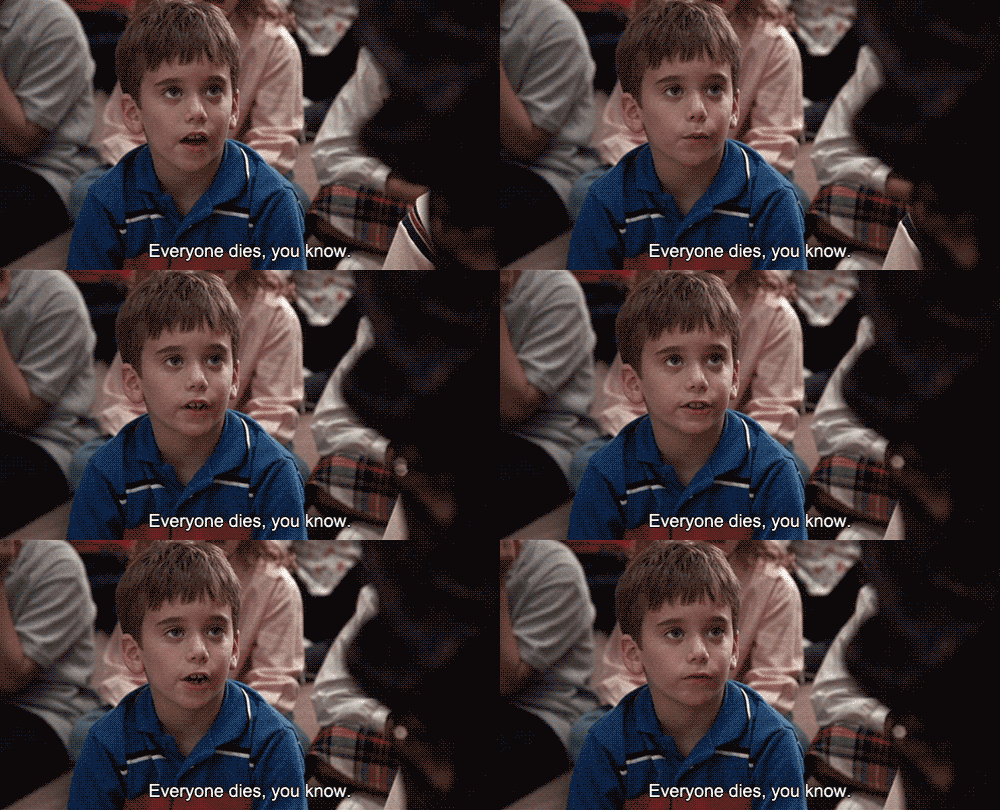
1.      The Everybody Dies Ending
I suppose some people find this one deeply literary or meaningful. I call it offensively manipulative and a total cop-out. It’s a cheap and often pretentious ploy that only worked when Shakespeare did it, and even then I thought it was a bit much.
He will grow up to write really depressing novels.

2.      The Deus Ex Machina Ending
The bane of my existence. For those of you who don’t know, deus ex machine is, to quote Wikipedia, “a plot device whereby a seemingly unsolvable problem is suddenly and abruptly solved with the contrived and unexpected intervention of some new event, character, ability, or object. It can be roughly translated as ‘God made it happen,’ with no further explanation, and, depending on usage, is primarily used to move the story forward when the writer has "painted himself into a corner" and sees no other way out”.

Basically, the resolution does not come from the characters. It is not inherent in the story, set up from the beginning, arising from the painful development the main character has undergone. No. A great force pops out of the sky, waves a magic wand, and POOF! Things are all better! I’m looking at you, Aslan (aka the Deux ex Lion)

3.      The Rainbows and Puppies Ending
This basically means that everybody lives happily ever after. To me, it’s preferable to the Everybody Dies ending, only because it doesn’t severely bum me out. But this chosen resolution is both immature an unrealistic. Life is messier than this. There are consequences even when you achieve your goals. I like when the author chooses not to tie up every thread with a pretty pink bow. 

KEEP READING! There is Ryan Gosling after the jump.