Pages

Showing posts with label romance. Show all posts

Thursday, June 9, 2016

The Good, the Bad, and the DNF


Mini review time, because I'm laaaazyyyyy and, well, I have barely been reading lately (slumps, they are the WORST), so let's catch up on some of the books this year I forgot to review.

Monday, March 7, 2016

Fun-Size Reviews


Fun-size reviews! For when you want a little bite of a book, and your trust YA blogger is feeling far too lazy to say much more about them!

I have been buuuuuuusyyyyy lately, so while I've definitely been back in the reading swing (thanks to the magic of romance novels) after a TERRIBLE reading February, my brain is still all limp and tired and sleepy and doesn't want to write reviews. It just wants to Netflix. And read more Tessa Dare. SO. TEENY TINY FUN-SIZE REVIEWS, like it's Halloween and you came to my door and I plopped a few teeny tiny reviews in your plastic jack 'o lantern bucket. (American traditions are really weird.)

Wednesday, March 2, 2016

When a Scot Ties the Knot (or When a Grump Beats Her Slump)


Goodreads | Amazon | Barnes and NobleThe Book Depository
Series: Yes, #3 in the companion series Castles Ever After
Release date: August 25th, 2015
Publisher: Avon
Length: 376
Source: gift

GUYS GUYS GUYS GUYS GUYS.


This is going to be part review, part fangirling, and part me battering on about how my evil slump is FINALLY, FINALLY BROKEN! And it's all thanks to Tessa Dare and the wide world of historical romance.

Monday, June 10, 2013

Review: Faking It by Cora Carmack


Review: Faking It by Cora Carmack
Goodreads
Release date: June 7th, 2013
Publisher: William Morrow & Company (HarperCollins)
Rating: SWOON.

 Faking It (Losing It, #2)

Mackenzie “Max” Miller has a problem. Her parents have arrived in town for a surprise visit, and if they see her dyed hair, tattoos, and piercings, they just might disown her. Even worse, they’re expecting to meet a nice, wholesome boyfriend, not a guy named Mace who has a neck tattoo and plays in a band. All her lies are about to come crashing down around her, but then she meets Cade.

Cade moved to Philadelphia to act and to leave his problems behind in Texas. So far though, he’s kept the problems and had very little opportunity to take the stage. When Max approaches him in a coffee shop with a crazy request to pretend to be her boyfriend, he agrees to play the part. But when Cade plays the role a little too well, they’re forced to keep the ruse going. And the more they fake the relationship, the more real it begins to feel.


The cover: Eh. It's romance-y and cute enough. They made a game attempt at showing Max's tattoo and dyed hair, but it's not really enough.

The story: MY GOD, do I love this book. Cora Carmack is, to me, everything that's RIGHT with the emerging New Adult genre (and this book is most definitely new adult-- a warning for those who like their books pure and squeaky clean). Faking It focuses on characters, and the plot is derived from those characters and their flaws. But oh, yeah, it just so happens to be SMOKING HOT and wildly romantic. Which works for me.


I read and loved Losing It a long time ago, so I knew I loved Carmack's funny, charming, easy style. But to me, Faking It was even better. The characters are punchier, rawer, and overflowing with personality. I did not want to put this book down. It focuses on Max and Cade, who, if you read the synopsis, start to fake a relationship for her family's sake. But this one form of "faking it" leads them to realize all the other myriad ways they're "faking" their own lives--faking being over their pasts, faking fearless, faking a lot of things.

There's a surprisingly amount of depth in this book. Max and Cade both deal with a lot of emotions, and therefore we do, too. I like a book that manages to balance the lighter, flirtier, sexier stuff with a real emotional journey. Also, this book switches first person POVs between Max and Cade, which I'm always super skeptical about (it's REALLY hard to pull off), but which I think works really well here.

Cade: Perfect boy is perfect. And yes, sometimes that can lead to perfectly bland, but oh, Cade is one of the best sincerely good characters I've ever read about. I loved him (and pitied him) in Losing It, and I loved him even more in Faking It. I'm not sure how Carmack managed to give him so much personality, but she did. Sweet, sexy Cade made me laugh like a hundred times.


Max: MAX IS AWESOME. She's one hundred percent the opposite of Bliss (and absolutely nothing like me, which I LOVE). Simply put, she's a bad-ass. She's damaged, she's bold, she's tattooed, she's a singer in the band, and she's fully, one hundred percent aware that she's a fuck-up. She's pretending to be something she's not so that she won't upset her crazy conservative parents--and so they won't cut her off. Which means she definitely can't introduce them to Mace, who is pierced, tattooed, and usually chemically enhanced. (What I love about Max is she's totally above drugs.) Enter Cade, the preppy-perfect guy her parents always dreamed she'd find, and one hundred percent not Max's type.

OR IS HE?

Max + Cade:

 
 CHEMISTRY, man. Chemistry. These two characters make so much sense for each other I don't even know what to say. Not just physically, either--emotionally, they are a really healthy match, and it's totally swoony and awesome to watch them figure each other out. The emotional obstacles blocking their way to twue wuv are totally natural and justifiable and don't feel author-manufactured. Basically, I shipped them hardcore.


If I were to pick any nits I'd say chapter 27 should have been about fifty pages longer, and Milo the Mexican friend was a little too wise and convenient. And a little annoying. But obviously, if you like swoony romance, a fun time, and laughs galore, I DEFINITELY recommen you check out Faking It. Also, I met the author at BEA, and she was super charming and totally worth standing in line for for about 1234567654 hours. So yay!

Thursday, May 16, 2013

Review: This Is What Happy Looks Like by Jennifer E. Smith


Review: This Is What Happy Looks Like by Jennifer E. Smith
Goodreads
Release date: April 2nd, 2013
Publisher: Poppy
Rating: Totally adorable and squee-worthy, with a few issues like flat characters and strange plot points. But I definitely recommend it if you need a cute summer romance with great prose.

 This Is What Happy Looks Like

 If fate sent you an email, would you answer?

When teenage movie star Graham Larkin accidentally sends small town girl Ellie O'Neill an email about his pet pig, the two seventeen-year-olds strike up a witty and unforgettable correspondence, discussing everything under the sun, except for their names or backgrounds.

Then Graham finds out that Ellie's Maine hometown is the perfect location for his latest film, and he decides to take their relationship from online to in-person. But can a star as famous as Graham really start a relationship with an ordinary girl like Ellie? And why does Ellie want to avoid the media's spotlight at all costs?


The cover: I love this cover. That sunny, happy yellow,  the silhouettes on the boat, and the font style all appeal to me. I think I like it even better than the cover for The Statistical Probability of Love at First Sight.

The story: Notting Hill is one of my favorite movies. I've seen it an incalculable number of times (mostly for Spike, the daft Welsh roommate, but also for the uber cute love story and the Hugh Grant factor). I'm a sucker for the famous-person-falls-in-love-with-a-regular-person trope, because it has the potential to be oh so cute and cliche and fairy tale-esque. That aspect is really well captured.

Graham, lonely teen Hollywood superstar, falls in love with Ellie, the everyday girl from Henley, Maine with scandalous parentage, through a lengthy email exchange. It all started when Graham mistyped an email and accidentally sent it to Ellie. Neither knows who the other is, yet they strike up an online relationship, divulging all sorts of details about their lives, except for who they actually are. Graham and Ellie are just plain cute together. In a way that would make the more cynical among us gag, probably, and those with their insta!love feelings acutely tuned will most certainly grumble, but for some reason I didn't. I say it's not insta!love, since they have been talking for months and months before they actually meet.

So they meet, and sparks fly, and all the things you want and expect begin to happen. There are paparazzi, and movie schedules, and Ellie's mom is totally terrified of the press, and Graham and Ellie go on super cute dates. The best part of the book is the Graham-Ellie connection, which has nothing to do with fame, but everything to do with the connection they forged through their emails. And the cute things they say to each other. Being all cute and falling in love.

http://24.media.tumblr.com/tumblr_ljsy9hltqN1qext3qo1_500.gif


This book is a quick, breezy, squee-worthy read, all of which are major pluses. After the emotional trauma that was Siege and Storm, I just wanted to go on a brain-cation in Maine and fall in love with a movie star. And I did. But I guess this book didn't capture my feels the way Smith's other book, The Statistical Probability of Love at First Sight, did. Maybe it was because I didn't get a lot of depth out of the characters? I'm not sure why. Graham and Ellie were reasonably fleshed out, but the drama with her best friend, Quinn, never sank in for me. I wish we'd gotten a sense of their relationship before their fight. Also, I think Quinn was rather cruel to Ellie and greatly overreacted, so the drama between them just sort of made me grumpy.

But it was the plot point with Ellie's father that really bothered me. The reason Ellie's mother is so wary of photographers is because Ellie is the illegitimate daughter of a senator (it's not a spoiler). I wasn't really a fan of how this played out. It felt unresolved, and it also felt a bit... meh. I'm not sure. It just didn't seem like a big enough deal to me. I felt like more should have come out of it.

That being said, I love the way Smith writes. I think she uses really beautiful language and lovely metaphors. I love the way she creates Graham and Ellie's bond. Again, it's all just so CUTE. Together, they do find what happy looks like. Even though there's no violin-playing goat, which is weird.

http://s1.favim.com/orig/4/happiness-julia-roberts-notting-hill-Favim.com-156437.jpg

I also found it strange that Smith never talked about any of the kids Ellie goes to high school with. It feels like only three teenagers exist in all of Henley: Ellie, her best friend, Quinn, and this boy Devon. It's summer, and there's a movie shooting in town. I feel like you'd see your classmates everywhere, right? And you'd talk to them? Because you know more than three people in your life? You have friends beside Quinn and your own mother, right?

Basically, I loved all the cute, romantical parts of this book but had issues with all the dramas. Not that I wanted the book to be drama free, or anything (even though a small part of me just wanted to read about Graham and Ellie going on happy dates in the sunshine forever and ever like really bad fanfiction because they're SO CUTE). But I didn't really like the way the drama was introduced. Like, when Graham and Ellie hit this rough patch. It kind of... comes out of nowhere. Ellie freaks out about the fame thing, which is understandable, but sudden and dramatic and weird. And then Graham was all sad, and I was all sad.

http://25.media.tumblr.com/d82a73f7a68f2596186ecfdd7da780ac/tumblr_mhzyaq7hzR1qe5ugfo7_250.gif

I get it. I live in LA. I've seen the paparazzi literally Apparate out of nowhere and crowd the sidewalk and flash all these scary blinding lights in a celebrity's face before. That is understandably a roadblock to true love. But still.

Though this one's a mixed bag, ultimately I think the book falls onto the positive side. I actually liked the insta!love aspects here, even though I really wish we could have seen more of their email exchange, and more of what life was like before the summer they met while they were emailing. But hey. I was in the mood for something saccharine. I was in the mood for cliches and total suspension of belief. I wanted a little less blandness, a little more real drama, and a little less niceness, but I got a very cute love story, I thought, so in the end, I was satisfied.


https://blogger.googleusercontent.com/img/b/R29vZ2xl/AVvXsEi5bDoebpIsPkqn9bKpQHdIqpZcx2O2wcKjDRYWz-B4_3hcNXopzMXYS2jL0kwpEZ5IVQIfaGIb2UA3lnRQV_9G3qEEXfB23Wsieo90vLA0mbf8YZQ_Px27fDm5Eer9cZag3zb9fqlNkQmv/s1600/rhys-ifans-in-notting-hill.jpg
Just because.


Thursday, April 4, 2013

Review: The Statistical Probability of Love at First Sight by Jennifer E. Smith


Review: The Statistical Probability of Love at First Sight
Goodreads
Rating: A cute and charming contemporary read which, while predictable, did warm the cockles of my old, cold heart. Good for fans of Anna and the French Kiss, The Sisterhood of the Traveling Pants, and Just One Day.

The Statistical Probability of Love at First Sight

Who would have guessed that four minutes could change everything?

Today should be one of the worst days of seventeen-year-old Hadley Sullivan's life. Having missed her flight, she's stuck at JFK airport and late to her father's second wedding, which is taking place in London and involves a soon-to-be stepmother Hadley's never even met. Then she meets the perfect boy in the airport's cramped waiting area. His name is Oliver, he's British, and he's sitting in her row.

A long night on the plane passes in the blink of an eye, and Hadley and Oliver lose track of each other in the airport chaos upon arrival. Can fate intervene to bring them together once more?

Quirks of timing play out in this romantic and cinematic novel about family connections, second chances, and first loves. Set over a twenty-four-hour-period, Hadley and Oliver's story will make you believe that true love finds you when you're least expecting it. 


The cover: I LIKE. I like the chalk writing font, letting the awesome tittle do all the heaving lifting, the pop of red against the black and white, and the way the blurred figures make the pavement look all rainy and London-y. The cute couple looking oh so Oliver and Hadley-like. Seriously, it's so rare that couples on covers actually look a thing like the characters inside the books.

The story: Despite my previously stated misgivings about insta-love, I had seriously high expectations going into this book. Nearly every review I've read has been complimentary, and sometimes there's nothing better in the world than a lovely little contemporary romance. And this book really was lovely, and a fast read to boot. I read it at precisely the right time, when my head needed to be up in the clouds with Hadley and Oliver, falling in love at first sight.

What I love about this book is that they don't actually fall in love at first sight. There were no premature declarations, namely this unspoken ithing between Hadley and Oliver that was clear as daylight. Smith didn't have to work to convince me why Oliver and Hadley would be magic together; I could see it on the page. This book had fun with the idea of what if, which is why the insta-lovey-ness worked for me. What if you did find yourself in this situation? And there were other things at play, like Hadley's serious daddy issues.

 I love that TSP played with all these ideas about what love is, what it means, what makes it true, and how long it's meant to last, when really the only thing that makes love love is... love. Also, it really makes me want to book a flight to some far off locale right now and somehow maneuver myself into sitting next to the hottest guy around, but even if I did, I bet a million bucks he'd never be as cute or flirty as Oliver. I never get put next to hot guys. I get put next to fat dudes who snore or cranky ladies who eye my copy of Cosmo like it's the devil's handbooks or children who cry. Where's my Oliver, dang it?!

Hadley does have some issues though. Her father left her mom to go live in England, fell in love with a British lady, and is getting married. Hadley is understandably not too keen with this whole arrangement, and is harboring some serious justified resentment.

Not exactly Hadley's current opinion.

 Divorce is a tricky issue. It can be a trigger for some people, either people who hate reading books that "normalize" it, or people who have suffered through it. I'm not here to tell you what to believe when it comes to divorce, but I will say that I don't think Smith trivializes love. While she does talk about the impermanence of some types of love, I think she does make a serious case for the real stuff. It's just about recognizing which loves are real, which ones can sustain even with all the hard work love requires, and which won't, no matter how hard you work at them.

For the record, my parents are divorced, though they divorced after I graduated high school. While Hadley's situation didn't really relate to mine in any way, Smith wrote her emotions so deeply and beautifully that I felt like they did. I'm not ashamed to admit I shed a tear or two during the latter half of this novel, though I'm just going to pretend it was because it was early in the morning and I was punchy and there was a branch in my eye or something. Anyway, there were bittersweet moments and straight up sweet moments, too.

http://celebquote.com/wp-content/uploads/2012/12/easy-a.gif

I liked Hadley.She's so... real, if a fictional character can be real. She's so open about her feelings and memories, even though the distance of third person narration, that I really got to step into her shoes. Smith has an amazing ability with creating the perfect little flashbacks and textural moments to fill in the details of Hadley's family life. I got a sense of her past with only a few anecdotes. Not a lot of writers can do that. This means you suffer through that ghastly, draining, graying feeling of watching her family come apart and her past get redefined and her future turn into a mess of uncertainties, but you also get to experience the fluttery moments of squee that constitute her dealing with the delightful Oliver.

OLIVER. Smith did such a good job with him. He needed to be immediately likeable and charming to carry off behind a love-at-first sight love interest. But the best part about Oliver was that he got better at second and third and fourth sight. I love his made up facts and sense of humor and British-ness.

I picture all Brits as aggressive tea-drinkers.

 He was, in a word, adorable, and contained a surprising amount of depth. This wasn't really insta-love. Insta-attraction, maybe, but they really did bond, and there was no pledge of everlasting love within moments of their meeting. Heck, I was half in love with Oliver only ten pages after meeting him. By the time they land in London, I was utterly smitten. I wish the plane ride has been longer, actually, and that Smith had included more of it.

The few drawbacks to this otherwise adorable little book was the predictability of the storyline with Hadley's dad and stepmother-to-be. I always like more conflict, and I felt the resolution there was a little too sugary sweet, bordering on cliche. I also kind of wanted Hadley to stick it to her father and truly show him how much he's wounded her, but I'm far less mature than Hadley was by the end of the book, which is why fate always sits me next to the snoring arm-rest usurpers and motion-sick ladies.

The writing is easy, smooth, and at moments almost awesomely profound. I actually stopped to pull aside a couple quotes here and there. They're the kind of quotes you can just see teen girls pinning on Pinterest or reblogging on Tumblr. Poetic, sweet, and surprisingly deep, kind of like this book.

Sunday, March 31, 2013

Insta-love: An Insta-Turn Off


Yea or Nay: Otherwise titled Insta-love and Why I Think It's a BIG NO-NO

Only when it's you, Ryan Gosling.

When I see insta-love approaching, I usually react like this:


Insta-love, for those blissfully unaware, is when two characters fall in love pretty much at first sight or soon after. There is no history between them and hardly any basis for their feelings beside mutual attraction. It's usually accompanied by many fervent declarations of everlasting love and a lot of mooning.

I've said it before and I'll say it again: I love romance. Love it. There's almost nothing more wonderful to me as a reader than watching two characters slowly and realistically come together.

See the key words there? Slowly and realistically.

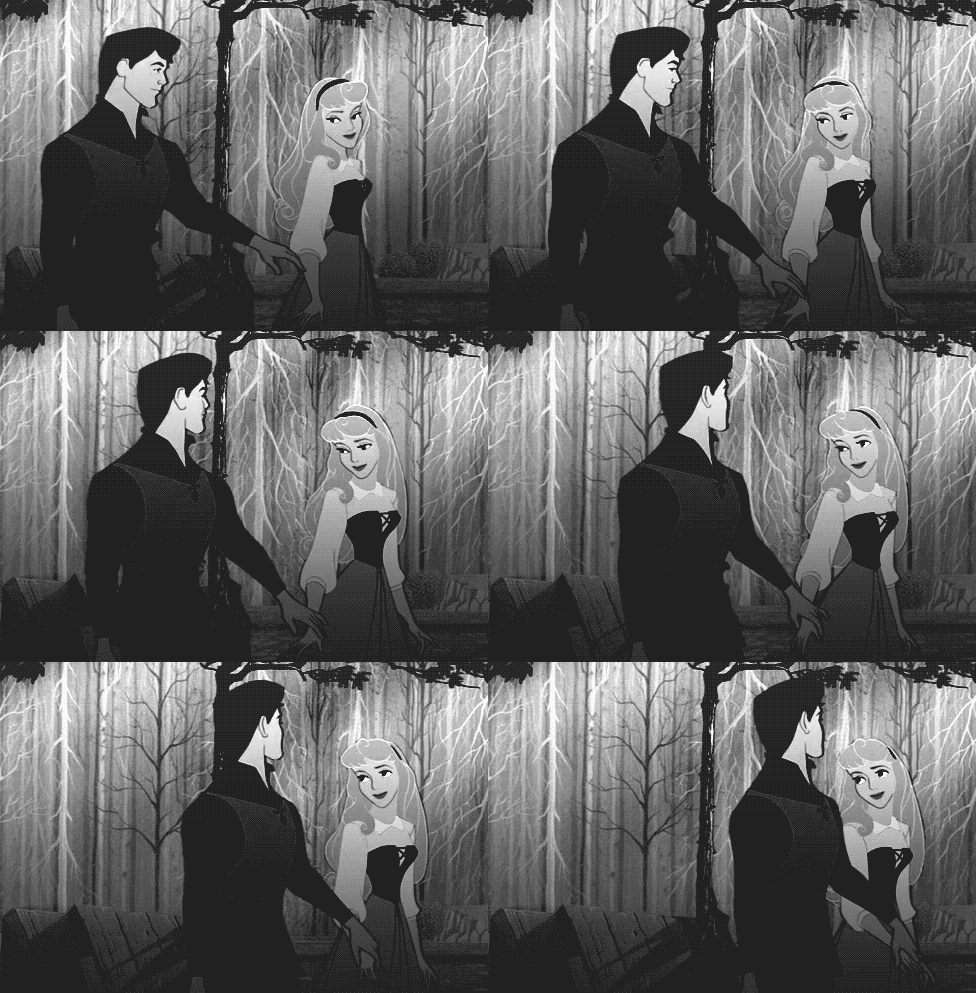
Romeo and Juliet is the most famous and most classical example of insta-love in literature. Nearly every romantic fairy tale and their accompanying Disney adaptation includes insta-love. Snow White and Prince Boring meeting by the wishing well. Aurora and Prince Philip the Sexy dancing in the forest. Cinderella and Prince Epaulets waltzing about the palace gardens.
http://25.media.tumblr.com/2cfd59801e917634388e4cb2d8acc5c6/tumblr_mja5tltERk1rt1ivno1_500.gif

If we don't see how they fell in love, then we'll never understand why they are in love. Just because an author claims something on the page doesn't mean we're going to believe it. And when it comes to romance of any sort, readers are quick to put on their skeptical pants. They give it a good once-over before buying into it. What I'm saying is, the love has got to be "real". Or else we react thusly:
image
All she REALLY wanted was for Snow and Prince Charming to stop singing at each other.

Insta-love vs. Insta-attraction

BIG difference. Insta-attraction happens all the time in real life and in novels. Let's say you're reading about a main character named, um, Julie. Julie is standing in line at Starbucks when someone accidentally bumps into her from behind. She turns to yell at this monumentally stupid person and whoa. Lo and behold, behind her stands a tall, rumpled, sexy dude with gorgeous blue eyes and a devastating crooked smile. The fat paperback tucked under his arm is the same book that's in Julie's purse. Julie's whole body lights on fire and her heart flips over and she forgets how to form sentences. It's like being struck by lightning.

That could be a wonderful start to a love story. I don't need for the two main characters to instantly hate each other, Beatrice and Benedick style (though it's super fun when they do). But as long as these people don't instantly decide they love each other, then it's okay. I mean, what if he's secretly a spy? An assassin? Engaged to her nemesis? Gay? Taken a vow of celibacy? Royalty? Any kind of complication or obstacle will do.

Let's say Julie and the blue-eyed, coffee-drinking sexpot (let's call him Jim) decide to sit down and have their coffees together. They have a lot in common and their chemistry is pretty much off the charts. Julie can react in several ways. She can think Oh my giddy aunt, Jim is amazing. I could totally see myself falling in love with him someday. Maybe I should ask him out. Or she can think Oh my giddy aunt, I'm already desperately in love with him. If a crazy wizard came in here and started Avada Kedavra-ing everybody, I would jump in front of him and die in his place. Because love.


You should know by now which option I prefer.

"But Gillian!" you and Julie cry, tears leaking down your precious, naive faces. "Jim's amazing! It could happen! My parents fell in love that way! My best friend's cousin's college roommate met her husband in a coffee shop and they got married the next day and are still together and have forty seven babies and a dog!"


 But I will shake my head condescendingly and say, "That's lovely, my dears, but it is exceptionally boring. Real life is not fiction, and fiction is not real life. I don't want to read about your best friend's cousin's college roommate. I want to read about two souls growing together through trials and tribulations. I want to read about the hard stuff, the messy stuff, and the exciting stuff. Because that's the fun of romance."

Love is such an amorphous, individual thing that it's hard to say what's love and what isn't. I mean, what's the difference between love and infatuation? Time? Seeing past your original idealized version of a person? I don't know. It'll vary for every story. But basically, I want my book life to be better than real life. It has to be more believable than real life, because, guess what? Someone is making it up. Fiction has to be more believable than fact, so the reader is tricked into forgetting it's fiction. It's a hard thing to pull off, but hey. That's why they pay authors the big imaginary bucks.


The absolutely worst part of instalove to me is how much these characters insist  on verbalizing their twue wuv. When characters get all, "Blahh, my sweet, my turtle dove, I love you more than everything in the history of the universe and I'm in physical pain because we are not currently touching" after knowing each other a week, I roll my eyes and seriously consider throwing them both into a vat of boiling tar.


Seriously? You have a family. Friends. Pets. You care about Hottie McBlue Eyes more than your family? After one week? This is not romantic to me. This is pathetic.


I want the characters' love to be communicated through their actions, not their sappy words. Words can lie. Words can be fake. Actions? Not so much. I also need to be able to see what the two characters see in each other. Do they possess qualities that the other lacks, like Darcy and Elizabeth or Ron and Hermione, balancing and rounding each other out? Is the hero or heroine the first person to truly see and value something about the main character, the way Four always believes in Tris' capabilities? I want to see why these puzzle pieces fit together. I don't want the author to just tell me they do.

Logan knows a true love story when he sees one.

Of course, there are books where insta-love is done well-ish (cannot actually think of any right now, but I'm certain they exist), but I always feel like those are only pulled off by people who understand the trope and are working with it. I've never read The Statistical Probability of Love at First Sight, but I've heard that this is one of them. Obviously I could be wrong, since I haven't read it. But there. I named a book. My work here is done.

It's not the shortened timeframe of an insta-love romance that bothers me so much as the lack of build-up. If a lot of things happen in a book over a couple of days, a week, or a month, the author could possibly convince me with a love story. But things need to happen between the two characters. They can't just be attracted to each other, have a couple heart-fluttery conversations together, vaguely ponder a mystery of some sort, and then declare themselves. Those are often the characters who feel the need to inform each other every ten pages or so that they are desperately in love, like they're worried the reader has forgotten. "I love you," the hero will say, earnestly and with one manly tear glittering on his cheek (TM Dean Winchester), "more than my own flesh, more than the sun and stars," and the reader will say, "Yes, thank you, I've got it, you just said that, can we please move on with the plot?"


Brilliant YA author (and creator of one of my favorite love stories of all time) Veronica Roth has this to say on the matter:

Most of the time, for me, the problem is "You're Hot, So I Love You." That is: the only in-text justification for the intense feelings of the characters is their physical attraction. We get many paragraphs dedicated to description, but none devoted to conversation or experiences that transcend the physical. Maybe the author even tells us something like "they talked for hours about this and this and this," but we don't get to see any of it, so we remain unconvinced.

I love that. That's so perfect and exactly sums up what I'm trying to say. Because she's Veronica Roth, obviously she does it much more cleanly and succinctly and awesomely. We bloggers like to rail on about show vs. tell, particularly when it comes to romance. I want to see them fall in love with what's in the other person's heart. It's not the same if the characters and the author just tell me that they already have.

Day One: Meet. Day Two: MARRIAGE!

(Yes, I know technically Derek and Odette weren't insta-love, as they knew each other their whole lives. Although they did change their minds awfully fast. And those of you who don't know what I'm even talking about, shame on you. This movie is a classic.)

Ms. Roth also warns readers not to brace against insta-love at all times:

And for readers, of which I am one: it's not that I think we should stop evaluating love stories for their believability. But I do think that it's important to make an effort to experience a story alongside the main character, rather than standing over the main character with our experiences or beliefs in hand like some kind of anti-insta!love weapon. And if, after we put the weapon down, we still read something and say "this is insta!love and it's annoying," I say, fair enough. Even if you say it about my books. I promise.

First of all, I just love that she calls it "insta!love", like it's some kind of infomercial product you can buy for $19.99. Like it's a little magic potion that you can throw in someone's eyes A Midsummer Night's Dream-style and poof! The man of your dreams has been smitten by Insta!love! Act now and we'll throw in a free ShamWow!

Anyway, every word she said is true. If you don't believe the love story on its own merits, then the story failed. We shouldn't immediately dismiss a love story because it has insta-attraction or a shorted time frame, because that doesn't fit in with our real-life experiences of love (HAHAHA, as if I have real life experiences of love). But if the romance feels shallow, unbelievable, too fast, or if it skipped a lot of important steps, then by all means, brand it insta-love and dismiss it if you feel so inclined.


Since this is, technically, a "yea or nay" post, you're at perfect liberty to disagree with me. So what say you? Instalove: Yea or nay?

For reference, here's a Goodreads list of Popular Insta Love Books.


Thursday, January 24, 2013

In Defense of Love Triangles

 
For a full definition, see TV Tropes.

I know what you're thinking. Love triangles.


It seems like 8 out of 10 YA books nowadays have love triangles in them. Understandably, we are all love triangle fatigued. I'm going to let you in on a little secret here that you probably couldn't figure out from the title of this post: I like love triangles.

I mean, not automatically. I don't read the backs of books that say "TWO BOYS, TWO LOVES, ONE MARY SUE, ONE CHOICE" and go "Love triangle! Definitely buying it!" And some triangles I've come across kind of make me want to punch absolutely everyone involved. Some seem to be inserted into the plot merely to appear timely, since YA love triangles are all the rage. And sometimes they are so organic to the story-- sometimes they underline the themes so well, or are done so originally-- that you can hardly fault them.

"Hardly" being the key word there. Obviously some people hate love triangles no matter what. You are not in the wrong if you do. There's a lot to dislike about love triangles, particularly when they become involved with my own personal YA kryptonite: instalove. But that's a post for another day.

There's also a double standard when it comes to love triangles. Most (not all, obviously) pro-love triangle people think the ones where the girl protagonist is trying to choose between two guys are acceptable, because of all the tangly feeelings and confusion and whatnot. But if a guy (usually NOT the protagonist) is trying to choose between two girls (one of who probably is the protagonist), people see him as a prick. Then there are the fun people who think, because a girl is torn between two guys, she is a trampire.

But that could lead me in a whole other direction about how stringently we should judge fictional characters, but again, that's another post for another day.

Sometimes, sympathizing with a love triangle is really hard.

Yeah, this kind of drives me crazy (I say as I give my cat, Uma, a good neck scratch) 

But still, I love them. It all comes down to agency. I love it when characters need to make choices. And really good love triangles are not just about a romantic quandary. Really good love triangles signify something deeper. YA is all about making those mistakes and figuring out what directions you want to go in in life, and I think love triangles perfectly exemplify that. In some cases, the protagonist is torn between two suitors who personify battling concepts that that the protagonist is wrestling with (e.g.: Katniss vacillating between Peeta and Gale, who represent two totally different ways of dealing with oppression, different forms of humanity, different forms of what love-conquers-all can mean).


Yes, this can be used as a marketing ploy to sell thousands of Team Peeta and Team Gale t-shirts a la Twilight (which is also a love triangle I can defend, thematically, though I definitely have a whole host of issues with it). I am not a proponent of the nastiness that can occur from Shipping Wars (Chair and Dair fans, I'm looking at YOU, you vile heathens. Boy am I glad that's done), but I do love the devotion that shipping can inspire in fans.

I have been known to squeal when certain beautiful TV vampires
kiss certain handsome TV vampires.

Here is a fantastic quote from author Carrie Ryan that basically says what I'm trying to say way better than I ever could:

"To me, that’s the essence of a love triangle — each man is a viable choice for the heroine but each speaks to a different part of who she is.  The heroine isn’t choosing between two men, she’s choosing who SHE wants to be and that will dictate who the right match is."

Do we need more originality in our YA love triangles? Absolutely. 90% of them include some variation of "Beautiful but unassuming girl is torn between dreamy good boy and hot-as-sin bad boy", even though sometimes this variation really works for me (see both Shadow and Bone and Shatter Me/Unravel Me). Perhaps there should be more books where the main character is the one competing with another person for the love interest's affections, rather than being the object of the triangle.


This is proven to be significantly less popular, however, particularly when a girl is competing with another girl for a boy's affections, because then we kind of all want to call the Other Girl a skank and banish her to Siberia. Again, I'm not a fan of judging characters for their sexual/romantic choices, but I understand why authors don't choose to write about this triangle very often.

Naturally. You both have eyes, after all.

That's why I'm all for the non-traditional formations, like that nasty bit of business found in A Midsummer Night's Dream. Hermia loves Lysander. Lysander, luckily, loves Hermia. Demetrius loves Hermia also, but she does not love him. Helena loves Demetrius, but he barely even knows who she is. To quote Seth Cohen, it's a love rhombus.


Or there could be non-traditional love triangles in which NO ONE is happy. Say X is in love with Y, Y is in love with Z, Z is evil soulless demon who loves nobody. Or X loves Y, Y loves Z, Z loves X or Q or maybe his horse or his mother, I don't know. Or even better, you read a love triangle where bits of the triangle are of the same gender, like that fun messy nonsense that is The City of Bones SPOILERSPOILER (Clary loves Jace, Jace loves Clary, Simon loves Clary, Simon is the most friend-zoned friend to ever be friend zoned, Alec loves Jace, Alec is the other most friend-zoned friend to ever be friend-zoned, OOPS Clary and Jace are brother and sister, never mind, pain everywhere) SPOILERSPOILER.

I myself happen to prefer the triangles that are truly triangles, rather than "love V's", as author Malindo Lo defines them. Basically, a triangle means that all three people in the tangly little love snarl have relationships. Take, for example, the Triangle of Doom in The Vampire Diaries (I haven't read the books, so I'm going off the TV series here): Stefan and Damon are vampire brothers, and they are both in love with Elena, she of the beautifully shiny hair. This is made much more interesting (to me) due to the fact that Stefan and Damon also love each other more than anything (even though they also want to kill each other sometimes. It's complicated). Or Will, Jem, and Tessa in The Infernal Devices trilogy, which I also haven't read but fully intend to. Or Celaena, Dorian, and Chaol in Throne of Glass, which I completely adored. Or, to get all classical on you, Arthur, Guinevere, and Lancelot: the original Triangle of Doom.

I like it when my tangly snarls are truly tangly and everyone loves everyone else (or everyone hurts everyone else). I prefer this form of triangle to triangles were the two suitors have no relationship to one another at all, or ones where it is patently obvious which suitor is going to be chosen (see Matched by Ally Condie).

I also love original resolutions to love triangles. Sometimes I'm just like, "Choose them both, Elena! Run off to a free love compound and switch Sexy Salvatores every other night!" I also love those Kelly Taylor "I choose me!" moments. We surely don't get enough of those in YA.

 
So obviously, I think love triangles are going a little stale, since the only way I could defend them was to argue they should be totally revamped. But multiple romantic possibilities for a heroine is not automatically a bad thing. Even Jane Austen did it. Emma was torn between Mr. Knightley and Frank Churchill; Elizabeth had to figure out whether it was Darcy or Wickham who was more deserving of her love; both Elinor and the horrible Lucy were in love with Edward; Anne loved Wentworth, but he was flirting with Louisa even though he maybe-loved Anne but Mr. Elliot also kind of wanted to marry Anne (that was a mess); Fanny loved Edmund but Edmund loved Mary and Henry loved Fanny and Mariah loved Henry (that was an even bigger mess). But the more romantical entanglements, the merrier, I say!
 
Damon approves.
Also Knightley.
 
For further research, here's a great post from author Diana Peterfreund arguing that Twilight does not actually contain a love triangle with also some brilliant insight into Buffy. I actually kind of agree with her now regarding the Forksian Fellowship, though ultimately I say the Bella/Edward/Jacob deal still has triangular aspects.
 
So, love triangles. Love 'em? Hate 'em? It depends? Tell me your thoughts, your Ships, which triangles you want to burn with fire, and whether seeing the words love triangle in a blurb make you instantly put the book down or instantly pick the book up.